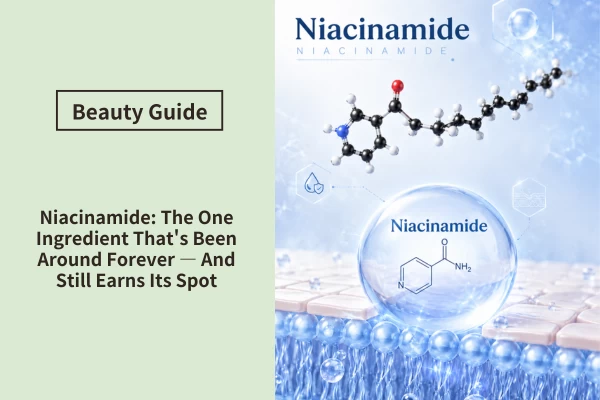
Before we get into the benefits, one thing worth clearing up: niacinamide and niacin are not the same thing. Both are vitamin B3, but they work differently on skin. Niacin (nicotinic acid) causes flushing — redness, heat, tingling — when applied topically. Niacinamide doesn't. This gets confused constantly in consumer forums and sometimes even in brand copy, so it's worth being precise. If a customer asks "doesn't it cause redness?" — that's niacin they're thinking of, not niacinamide.
What Niacinamide Actually Does (and Where the Hype Gets Ahead of the Science)
There's no shortage of claims made about niacinamide online. Some are backed by real clinical data. Others got repeated enough times that they started to sound true. Here's how to read the difference.
The benefits with solid evidence behind them
♦Brightening and dark spot reduction
This is where the research is strongest. Niacinamide works by blocking the transfer of melanosomes — pigment-carrying packets — from melanocytes into skin cells. It's not suppressing melanin production itself; it's interrupting the delivery. That's a different mechanism from arbutin or kojic acid, and it matters if you're layering multiple actives in a formula.
Most studies use 5% concentration over 8 to 12 weeks and show meaningful improvement in sunspots, melasma, and post-acne discoloration. This is why niacinamide brightening serums are still one of the most requested products in private label skincare manufacturing — the demand hasn't peaked.
♦Oil control and pore appearance
Around 4%, niacinamide visibly reduces sebum output over time, which makes pores look less prominent. Not structurally smaller — pore is mostly genetic — but less congested and easier to minimize with texture. Oily and combination skin brands love this, and the claim is easy to substantiate.
♦Skin barrier support
Niacinamide stimulates ceramide synthesis, which helps the skin hold moisture and resist irritation. For sensitive skin lines, post-procedure recovery products, and anything positioned around "barrier repair" — a category that's been growing steadily in the US market — this is one of its most useful angles. It pairs naturally with hyaluronic acid and ceramide complexes, and the combination is well-tolerated even by reactive skin types.
♦Anti-aging
It supports collagen production in the dermis and contributes to DNA repair via NAD⁺. Honest framing: this isn't the ingredient's strongest suit. It's a useful addition to an anti-aging formula, but it works better as a supporting player alongside a dedicated active like retinol or peptides rather than as the headline ingredient for that positioning.
Where brands sometimes oversell it
"Instant firming" is not a realistic claim for niacinamide. Its anti-aging effects build slowly — we're talking weeks to months of consistent use. Any brand making that claim is setting consumers up for disappointment, which hurts reviews, retention, and in the US, can attract FTC attention for unsubstantiated claims.
The ingredient earns its reputation by doing several things reliably well over time. That's worth more than promising a dramatic overnight result and not delivering.
How to Think About Concentration
Almost every brand we talk to for the first time says some version of "we want 10% niacinamide" — usually because they've seen a competitor running that number on the label.
Higher is not always better. It depends on who the product is for and what it's trying to do.
|
Concentration
|
Best For
|
Practical Notes
|
|
1–2%
|
Daily moisturizers, toners
|
Light and well-tolerated; good for sensitive or beginner-friendly positioning
|
|
3–5%
|
Brightening serums, hydrating ampoules
|
Where most clinical research sits; the sweet spot for most formulas
|
|
5–8%
|
Oil control treatments, acne-prone skin
|
Effective and noticeable; occasional mild sensitivity in some users
|
|
10%+
|
High-potency treatments
|
Needs careful formula balancing; irritation risk rises with concentration
|
Three formulation details that matter in practice
pH stability
Niacinamide is most stable between pH 5 and 7. Push below that — say, if you're adding AHAs to the same formula — and it can partially convert to nicotinic acid, which causes the flushing problem. This is not theoretical. It's something that comes up in real formulation work, and a good cosmetic contract manufacturer will flag it before it becomes a problem on your end.
How it's added to the batch
Niacinamide is water-soluble and needs to be pre-dissolved in warm water (around 50–60°C) before it goes into the main mix. Skip that step and you can end up with crystal deposits in the finished product — not a good look, and a sign of sloppy manufacturing.
Packaging
Higher-concentration formulas benefit from opaque packaging — dark glass, aluminum tubes — to slow light-induced degradation. If clear packaging is a priority for aesthetic reasons, the formula needs stronger antioxidant support built in. This is the kind of thing worth discussing with your manufacturer before you finalize your packaging design, not after.
What Pairs Well With Niacinamide (and What to Be Careful With)
Combinations that work
The most common pairing in private label skincare, and for good reason. No compatibility issues, complementary mechanisms — hydration plus barrier support — and it works for every skin type. If you're developing a first product and want something clean and approachable, this combination covers a lot of ground.
A natural match for sensitive skin, post-procedure recovery, or acne-focused lines. Centella's anti-inflammatory properties layer well with niacinamide's barrier-building effect. This pairing also fits the "minimal ingredients, no-irritant" positioning that resonates strongly with consumers right now — especially in the US market where ingredient-conscious buyers are the norm.
♦Niacinamide + Vitamin C Derivatives (AA2G, VC-IP)
Dual brightening with real synergy, when it's formulated correctly. The key — and we'll come back to this — is using a stable vitamin C derivative rather than pure L-ascorbic acid.
Built for barrier recovery. These two work through complementary mechanisms: niacinamide stimulates ceramide production, and added ceramides reinforce the effect directly. Standard for dry skin moisturizers and anything positioned around barrier repair.
Where brands get tripped up
♦Niacinamide + Pure Vitamin C (L-Ascorbic Acid)
This has been debated endlessly online, and the reality is more nuanced than most of the discourse. At low concentrations, moderate temperature, and a stable pH, mixing them in the same formula is generally not a problem. The issue comes up under higher heat during manufacturing, or when the formula's pH isn't stable — conditions where the two can react to form nicotinic acid and cause flushing.
The practical fix: switch to a vitamin C derivative. AA2G (ascorbyl glucoside) and VC-IP (ascorbyl tetraisopalmitate) are both significantly more stable than pure L-ascorbic acid. They pair with niacinamide without issue, and most consumers don't notice a difference in how their skin responds. Any experienced formulator will suggest this automatically.
♦Niacinamide + Low-pH AHAs/BHAs
Not ideal in the same formula at high concentrations. If a brand wants to combine brightening with exfoliation — a legitimate and popular product concept — the cleaner approach is two separate products with a morning/night usage split. It's a lower formulation risk and, honestly, an easier product story to tell to consumers.
OEM vs. ODM: What the Difference Actually Means for Your Brand
These two terms come up constantly in skincare contract manufacturing conversations, and they get mixed up constantly.
OEM (Original Equipment Manufacturer): You bring the formula. The manufacturer produces it. This applies to brands that already have a formulation — from an in-house chemist, a licensed formula, or a previous manufacturing partner. The factory handles production, not development.
ODM (Original Design Manufacturer): The manufacturer develops the formula. You choose a direction, they build it, and you sell it under your own brand. Most new brands, DTC founders, and creator-backed labels go this route because it doesn't require having a formulator on staff. Development cycles are shorter and the upfront cost is lower.
For most brands launching their first niacinamide product, ODM is the more realistic starting point. Use a manufacturer's proven formula to test your market, get real sales data, then decide where to invest in customization. That's a much lower-risk path than sinking budget into custom formulation before you know how the product resonates.
One thing to know about pure white-label ODM — taking an off-the-shelf formula and putting your label on it: the barrier to entry is low, but so is differentiation. Your competitor may be selling the same formula. If that bothers you, ask manufacturers about customized ODM: starting with their base formula but making modifications — adding an ingredient, adjusting texture, changing the scent profile. It's a middle path between full custom and pure private label.
Frequently Asked Questions
►Is niacinamide the same as niacin?
No. Both are vitamin B3, but different forms with different effects on skin. Niacin (nicotinic acid) causes flushing when applied topically — redness, heat, sometimes itching. Niacinamide doesn't have that reaction at normal use concentrations. This is one of the most common points of confusion in consumer skincare, and worth addressing clearly in your product copy if you're launching a niacinamide line.
►Can you use niacinamide with vitamin C?
Yes, but the form of vitamin C matters. Pure L-ascorbic acid can react with niacinamide under certain manufacturing conditions — specifically high heat or unstable pH — and produce nicotinic acid, which causes flushing. The straightforward fix is using a stable vitamin C derivative like AA2G instead. Most formulation teams will recommend this automatically once you describe what you're trying to build.
►Will the contract manufacturer share my formula with other brands?
Any reputable manufacturer will sign a Non-Disclosure Agreement as a standard part of onboarding. If they push back on that, take it seriously. If you're licensing one of their existing ODM formulas, it may not be exclusive to you — ask directly whether other clients are using the same base. If it's a formula you developed or co-developed with them, the NDA should protect that clearly. Get it in writing before you share anything proprietary.
►I run a dermatology practice and want to launch my own branded skincare line. Do I need special licensing?
No special medical or professional licensing is required to own a cosmetic brand. Clinic and medspa private label is actually a growing segment — smaller order volumes, stronger margins, and built-in customer trust from the clinical environment. Many manufacturers have handled this kind of project before and can accommodate lower minimum orders. It's worth asking whether they have experience with clinic brands specifically.
A Few Final Thoughts
Niacinamide works because it's genuinely useful — not because it's new or exotic. The ingredient does several things reliably well, plays nicely with most other actives, and fits into almost every skin concern category. That's a rare combination, and it's why it keeps showing up at the top of our inquiry list year after year.
If you're building a product around it, the ingredient is the easy part. The decisions that actually shape the outcome — concentration, formula design, ingredient pairings, packaging, positioning — are where a good manufacturing partner makes a real difference.
We're happy to talk through any of it.